Modern Luxury Home Staging: Is Luxury More Than Velvet and Gold?
October 5, 2026
By Natalia Ourban
Natalia Ourban is General Manager of Rent WOW!!!, a Toronto furniture and accessories rental company serving the home staging industry since 2009. Over more than 15 years, she has observed thousands of staging projects completed by Rent WOW!!! clients, including numerous luxury properties, and has seen first-hand how furniture trends, staging strategies and real estate market conditions have evolved over time.
What does luxury furniture look like?
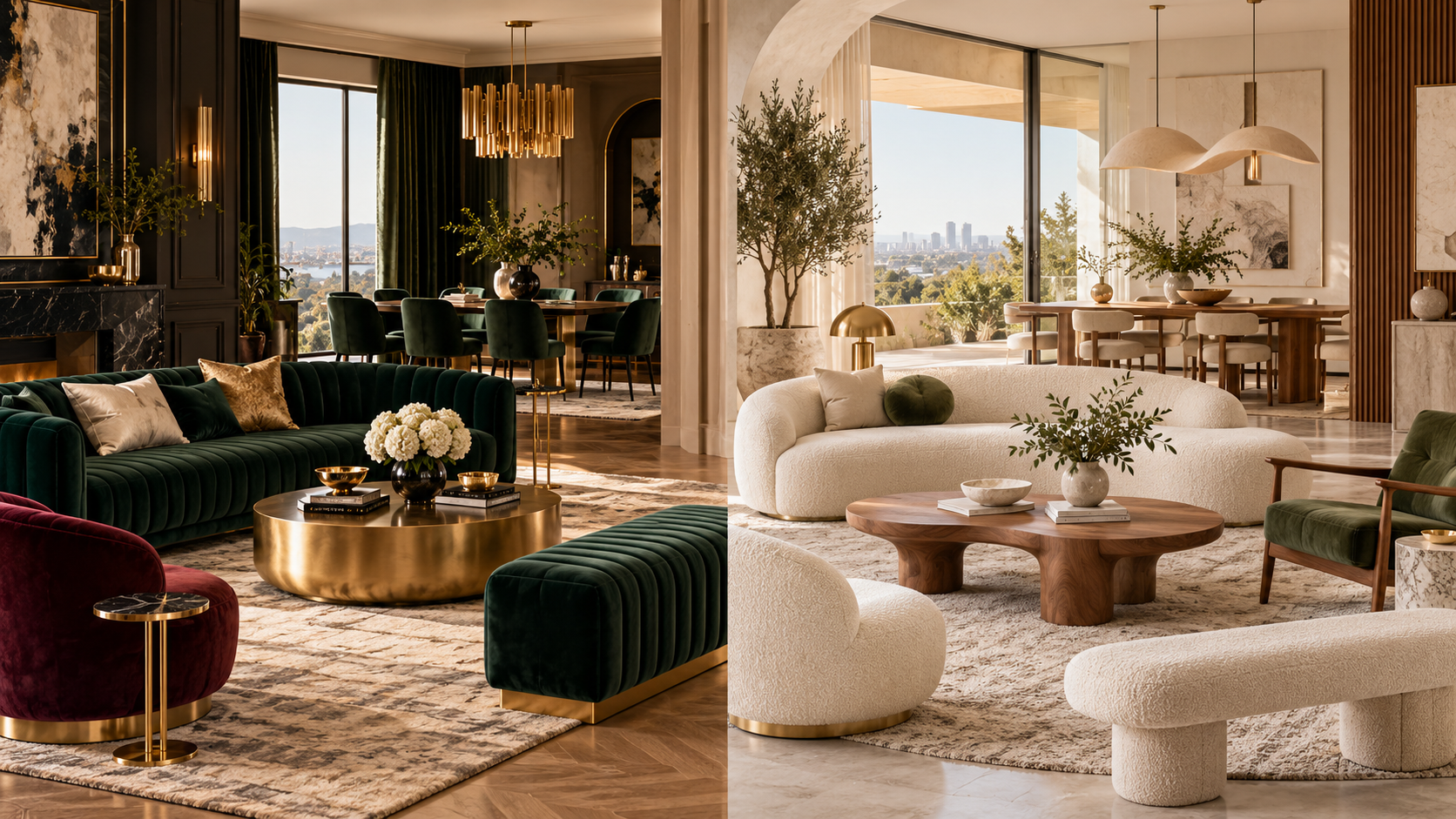
A few years ago, the answer seemed fairly obvious. Velvet upholstery, jewel colours, polished gold finishes, marble, dramatic lighting and glamorous details became visual shorthand for luxury interiors. These elements appeared everywhere, from furniture showrooms to staged properties. Today, the pendulum has swung in a very different direction. Contemporary luxury interiors are increasingly influenced by Scandinavian restraint, Mid-Century Modern design and more sculptural, Brutalist-inspired forms. Furniture has become heavier, simpler and more architectural. Natural woods, textured fabrics, substantial silhouettes and organic shapes have replaced much of the shine and ornament. But does that mean gold, velvet and colour are no longer luxurious? Not necessarily.
Luxury Is Not One Particular Style
One of the problems with staging trends is that a successful look can quickly turn into a formula. For a while, adding a velvet sofa, a gold coffee table and a few jewel-toned accents could instantly give a room a more glamorous appearance. Today, the formula has almost reversed: neutral upholstery, oversized sculptural furniture, chunky wood tables and organic forms have become the new visual language of high-end interiors. Neither approach should automatically define luxury. Our Rafael Sofa, for example, uses a curved silhouette, textured off-white upholstery and a thin chrome frame rather than traditional luxury detailing. Rafael Sofa
The Harmony Sofa takes this idea even further. Its gently curved back and arms flow into one continuous form, while its low profile, off-white upholstery and slender black legs give it a quiet, sculptural presence. There is very little decoration—the shape itself does most of the work. Harmony Sofa
The Bubblik Sofa offers another interpretation. Its broad seating, rounded integrated back and arms, low profile and almost floating appearance create a distinctly contemporary silhouette. In this case, the piece is also Italian-made and of high quality, showing that modern luxury can combine genuine manufacturing quality with an understated design rather than relying on obvious decorative signals. Bubblik Beige Sofa Bubblik Hemp Sofa
Form, Proportion and Materials Matter
Modern luxury is often quieter than the luxury interiors of a few years ago. Rather than relying primarily on obvious decorative signals, it can come from the scale of a sofa, the shape of a chair, the texture of upholstery, the visual weight of a coffee table or the relationship between several pieces in a room. Coffee tables are a good example.
The Timmins Coffee Table uses solid mango wood, visible grain and an irregular freeform top. Its Mid-Century influence and organic shape provide character without ornament. Timmins Coffee Table
The Ditter Coffee Table has an even more substantial presence. Made from solid mango wood in a rich mocha finish, it combines a freeform rounded top with thick panel legs. The effect is sculptural and contemporary, with the natural material and strong form providing the luxury rather than decorative embellishment. Ditter Coffee Table
The same shift can be seen on a larger scale in dining furniture. The Barnes Dining Table combines an oval form, visible oak grain, a wide pedestal and reeded detailing - a good example of Mid-Century-inspired design being interpreted for today’s interiors. Barnes Dining Table
The Anders Dining Table, at almost 80 inches long, provides the substantial scale that can be important in larger dining rooms, where an undersized table can make an otherwise impressive space feel poorly considered. Anders Dining Table
This is particularly important in staging. Homebuyers generally do not walk through a staged property examining furniture labels or asking where every sofa was manufactured. They experience the room as a whole. Does the furniture feel substantial enough for the space? Does it complement the architecture? Does it establish the correct scale? Do the shapes, textures, colours and finishes make the property feel current and considered? These questions often matter more in staging than whether every individual piece would qualify as luxury furniture on its own. A successful staged room creates a convincing overall impression.
Modern Luxury Does Not Have to Mean Neutral
Another change we are seeing is a renewed interest in colours drawn from nature. Earthier greens - including moss, olive and other muted botanical shades - have become increasingly prominent alongside natural woods and organic forms. Current design forecasts connect these colours with the broader movement toward warmer, nature-inspired interiors rather than the cool greys and stark neutrals that dominated earlier periods. (Homes and Gardens)
Our Forest Accent Chair is a good example. Its green upholstery is combined with sculpted walnut-coloured solid wood arms, tapered legs and a gently angled silhouette. The result has a clear Mid-Century influence but also reflects the current preference for colours and materials connected to nature. Forest Accent Chair
But colour is only one way to create interest.
The Tesla Accent Chair relies primarily on form and texture: a rounded barrel-style silhouette, chenille upholstery, tailored stitching and subtle horizontal channel detailing. Tesla Accent Chair
The Chord Accent Chair takes another route, combining an oversized rounded shape and textured bouclé upholstery with a walnut-grain base. Its appeal comes from softness, volume and proportion rather than glamour. Chord Accent Chair
Even smaller pieces can express the same idea. The Callisto Bench combines off-white bouclé with light solid-wood legs, while the Axel Bench uses a fully upholstered oval seat supported by two substantial column-style bases. One feels lighter and Scandinavian-influenced; the other is more sculptural and architectural. Both can contribute to a high-end room without relying on shine or ornate detailing. Callisto Bench Axel Bench
Luxury Staging Does Not Require a Showroom Full of Designer Labels
There is also an important distinction between furnishing a home permanently and furnishing it temporarily for sale. A homeowner purchasing furniture for personal use may reasonably consider craftsmanship, country of manufacture, natural materials, designer provenance and how an item will perform for twenty years. Staging has a different objective. Its purpose is to present the property effectively for a limited period of time. Using exclusively Italian-made furniture, authentic iconic designs, genuine leather and premium natural-fibre upholstery throughout a staged property would substantially increase the cost of acquiring and renting that inventory. Ultimately, those costs would have to be reflected in the staging budget. That does not necessarily create a proportionally better presentation. This does not mean that quality is irrelevant. We carry pieces such as the Italian-made Bubblik precisely because genuine quality has its place. But successful luxury staging does not depend on every piece having an expensive pedigree. Strong design, appropriate scale, convincing materials and finishes, and good proportions can create the required high-end impression without every chair, table and sofa needing to be investment-grade furniture. Poor proportions, obviously inexpensive finishes or badly constructed furniture can undermine a sophisticated property very quickly. The point is not that quality does not matter - It is that design quality and visual suitability matter more than labels alone. But We Shouldn’t Replace One Luxury Formula With Another.
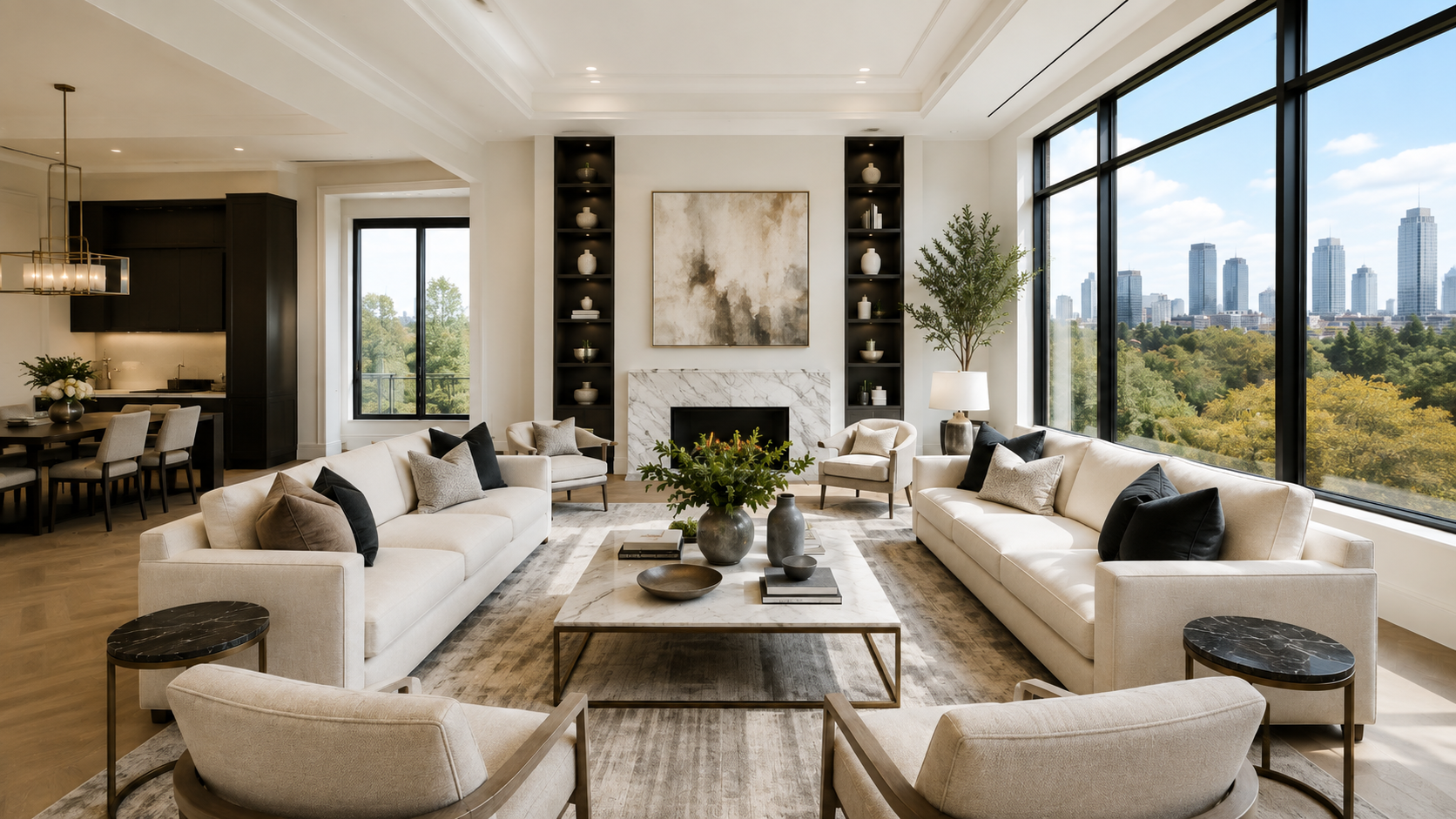
There is another danger in the current move toward sculptural modern furniture. Because Brutalist-inspired forms, Scandinavian restraint and Mid-Century Modern influences are fashionable, they can begin to be treated as the only acceptable expression of contemporary luxury. That would be just as limiting as assuming luxury must mean gold and velvet. Not every property suits heavy organic forms, pale upholstery and oversized wood furniture. A contemporary custom home with large windows, concrete, stone and open architecture may work beautifully with substantial sculptural furniture and restrained colours. A traditional home may need softer forms, richer materials and more decorative detail. An Art Deco-influenced condominium may look completely appropriate with polished metal, velvet and stronger colour. A dramatic penthouse might benefit from pieces that provide glamour rather than restraint. And chrome should not automatically disappear simply because warmer finishes are currently popular. The chrome frame of the Rafael Sofa is part of what gives the piece its light, contemporary character. Gold, too, still has a place. So do velvet and jewel colours.The issue is not whether gold, chrome, velvet or colour are fashionable this year. The question is whether they are right for the property.
Let the Property Lead
For professional staging, this may be the most important principle. Luxury should not be imposed on a home according to a predetermined formula. The architecture, age, scale, finishes and character of the property should influence the furniture selection. A multimillion-dollar contemporary house and a multimillion-dollar traditional residence may require completely different interpretations of luxury. Even two contemporary properties may call for different approaches. One may benefit from Scandinavian simplicity and natural finishes. Another may need dramatic sculptural furniture. A third may look stronger with Mid-Century references, chrome or richer colour. Furniture from Rent WOW!!! was used for the partial staging of this Blue Mountains luxury chalet, where the selections supported the property’s natural, contemporary character rather than imposing a more traditional idea of luxury. Blue Mountains luxury chalet project on Houzz
This is why having variety within a luxury furniture collection matters. The purpose of a luxury collection should not be to reproduce one fashionable aesthetic. It should provide enough different design languages to respond intelligently to different properties.
We explored this point in more detail in our earlier article, Staging Luxury Homes: Why Furniture Selection Changes in Multimillion-Dollar Properties, where we looked at scale, architecture, lifestyle and why expensive furniture is not automatically the right furniture for every luxury property.
Modern Luxury Is Broader, Not Narrower
Perhaps the biggest change in luxury interiors is not that one style has replaced another. It is that the definition of luxury has become broader. Luxury can be quiet or glamorous. It can be colourful or neutral. It can be influenced by Scandinavian design, Mid-Century Modernism or Brutalism. It can also include velvet, brass, chrome, glass or richer decorative elements. What makes the result successful is not following the latest luxury trend - it is understanding the property well enough to know which interpretation belongs there. For staging, that distinction matters. The objective is not to prove how expensive the furniture is. It is to make the property itself feel appropriately positioned, cohesive and desirable - sometimes that requires restraint, sometimes it requires drama, and sometimes a little gold is exactly what the room needs.
Follow us on Houzz to see other projects.